


Last updated: 26 November 2026 · By HEVO
Athletes wear blue light glasses at night because bright light late in the evening can push the body clock later, and they see sleep as a core part of recovery. Games under floodlights that end late, flights across time zones and long evenings with a phone in a hotel room all add light at the wrong time. The eye has cells that react most to blue light around 480 nm and pass that signal on to the body clock. Erling Haaland said in a 2023 interview, reported by ITV News and theScore, that he wears blue-light-blocking glasses for about three hours before bed and tapes his mouth at night. Haaland has no connection to HEVO. This guide explains why athletes care about evening light, what you can copy at home and what the research does and does not show. The short version: the habit is easy to try, but the evidence on sleep is still uncertain.
Why do elite athletes protect their evening light?
An athlete's evening is often full of light.
- Late games. A match under floodlights can end close to bedtime, and then come interviews and the trip home.
- Travel. Away games and tournaments mean new time zones and nights in unfamiliar rooms.
- Hotel rooms. Downtime on the road often means screens under bright ceiling lights.
- Recovery. After a hard session, the night's sleep is part of getting ready for the next one.
Light matters because it sets the body clock. Chang and colleagues (2015) found that reading on a light-emitting tablet before bed suppressed melatonin, delayed the clock and made it take longer to fall asleep, compared with a printed book.
What has Erling Haaland said about blue light glasses?
In a 2023 interview with Logan Paul, reported by ITV News and theScore, Haaland said he puts on blue-light-blocking glasses about three hours before bed. He also said he tapes his mouth at night.
To be clear: Haaland has no connection to HEVO. He is not a HEVO athlete and has not endorsed HEVO. We do not know which glasses he uses, neither the brand nor the colour.

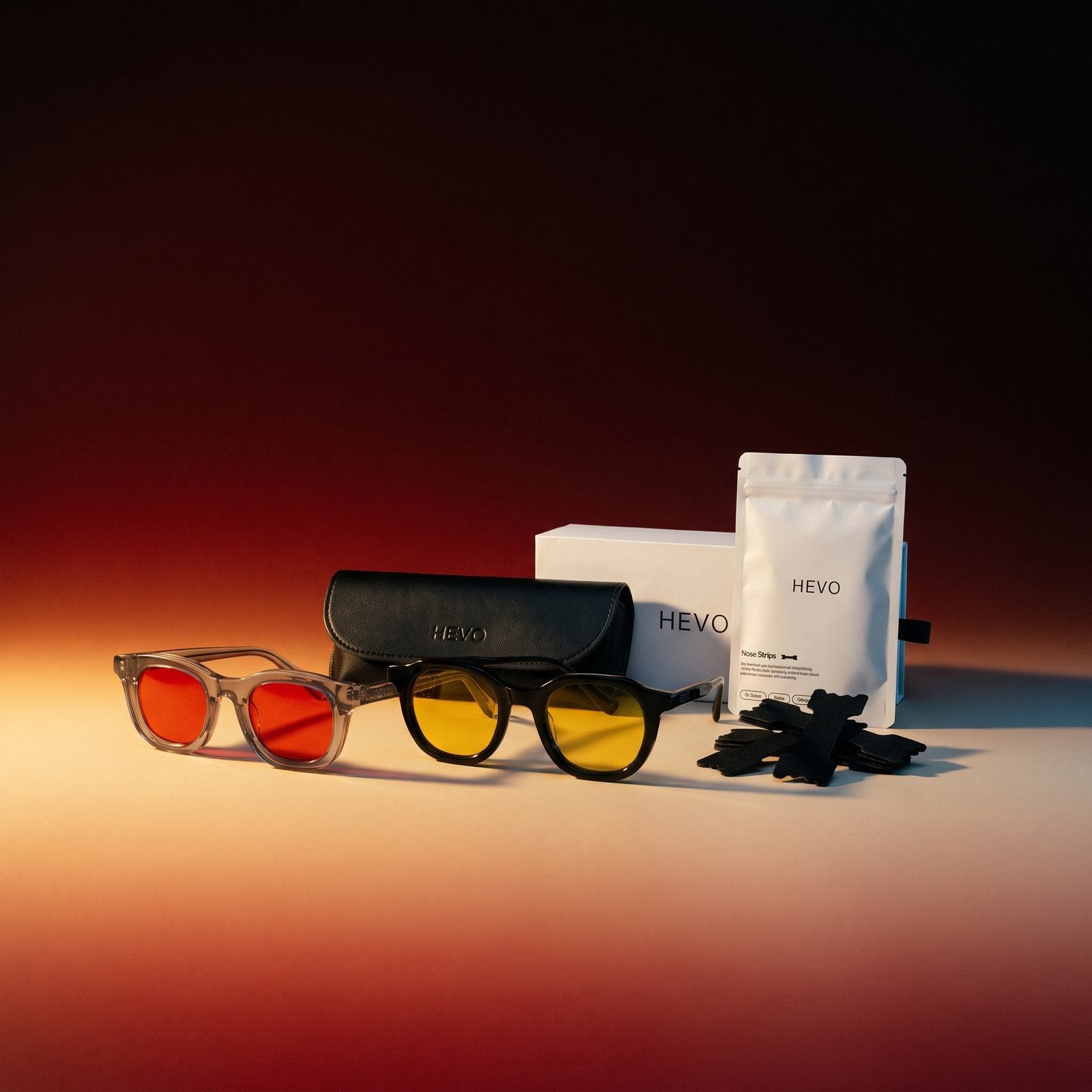
Why are some blue light glasses red?
The colour of a lens tells you what it filters. A red lens blocks more of the spectrum than an amber one, because it also covers green light. Typical clear "computer glasses" filter only about 20-30% of blue light.
| Lens | Colour | What it filters | When to wear it |
|---|---|---|---|
| Sleep Lens | Red | 99% of 400-560 nm | The last 1-2 hours before bed |
| Relax Lens | Amber | 97% of 400-500 nm | The early evening |
| Focus Lens | Light yellow | 84% of 400-450 nm | Screens during the day |
The percentage is the share of light inside that band that the lens filters out, measured with a spectrometer.
Which athletes wear HEVO?
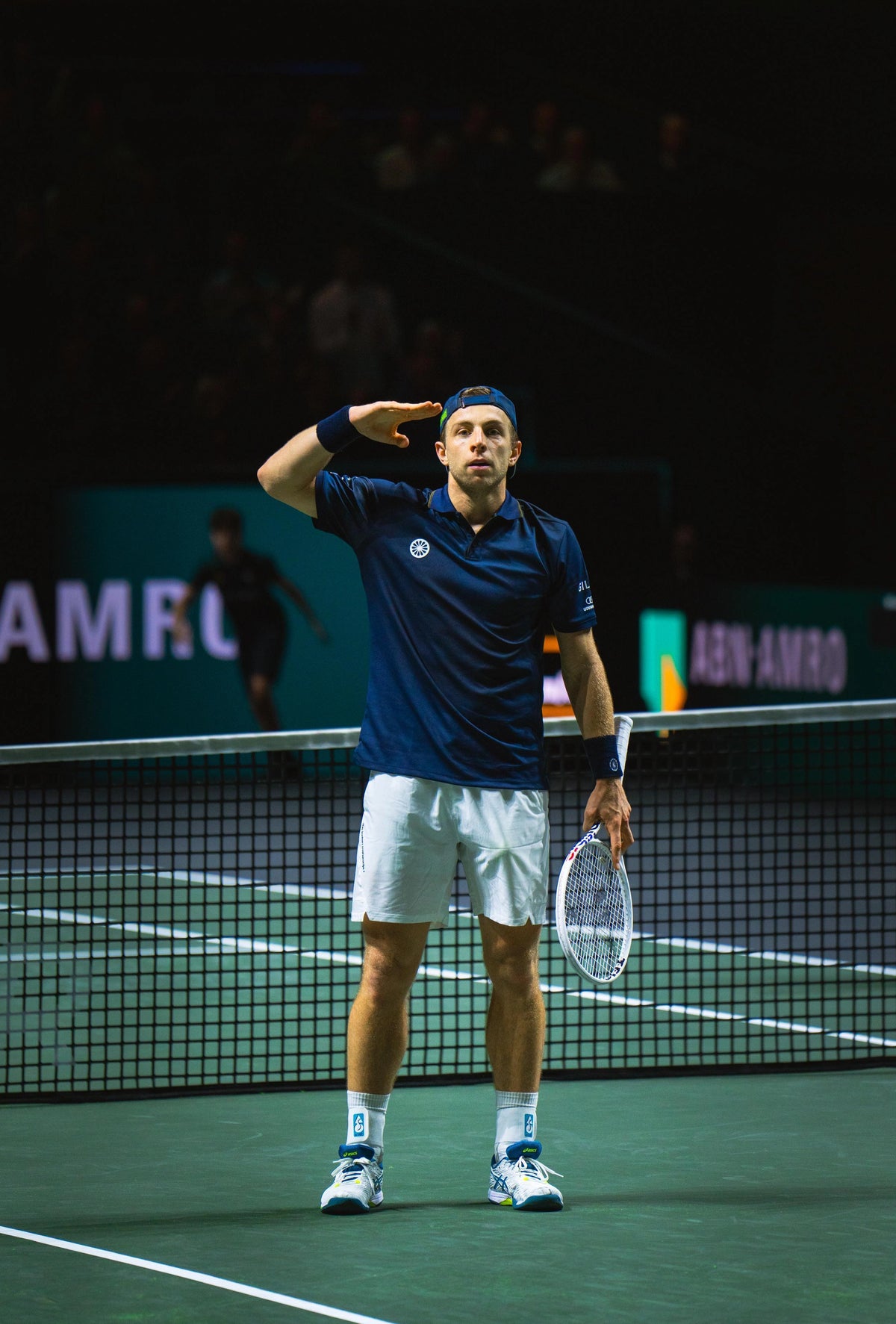
These professional athletes wear HEVO glasses:
- Tallon Griekspoor, tennis, Dutch no. 1
- Ronja Savolainen, ice hockey, Ottawa Charge (Finland)
- Frida Maanum, football, Arsenal
- Besfort Zeneli, football, Union Saint-Gilloise
They wear HEVO. We will not describe routines they have not shared themselves.
How can you copy an athlete's evening routine at home?
- Start about two hours before bed. For many people, melatonin starts rising in dim light roughly two hours before their usual bedtime. That is the window to protect.
- Match the lens to the hour. Relax Lens suits the early evening. Sleep Lens is for the last 1-2 hours before bed. Focus Lens is for screens during the day.
- Dim the room as well. Evening light at home is often 50-200 lux. Lower lamps and fewer ceiling lights make the evening darker still.
- Get daylight in the morning. Even an overcast day gives 1,000-10,000 lux, far more than an office at 300-500 lux.
- Mouth tape is a separate habit. It is not for everyone, and if your nose is often blocked, ask a doctor first. HEVO also sells mouth sleep tape.
For a more detailed timeline, read when to wear blue light glasses before bed. Every pair comes with 100 evenings to try.
What does the research actually show?
In a small randomised trial at Columbia, people with insomnia slept about 30 minutes longer on average with amber blue-blocking glasses than with clear placebo glasses (Shechter et al., 2018). A 2023 Cochrane review by Singh and colleagues judged the evidence on sleep as uncertain, with low certainty, mainly because the studies are small.
So see the glasses as one way to make your evening darker, not as a treatment. They can help some people wind down. If sleep problems persist, talk to a doctor.
Questions
Does Haaland wear HEVO glasses?
No. Haaland has no connection to HEVO. He has said in a 2023 interview that he wears blue-light-blocking glasses before bed, but he is not a HEVO athlete and has not endorsed HEVO.
Do I need red glasses, or is amber enough?
It depends on the hour. Amber (Relax Lens) is easier to wear in the early evening. Red (Sleep Lens) also filters green light and is meant for the last 1-2 hours before bed.
Can I wear them over my prescription glasses?
No. All HEVO glasses are non-prescription and are worn on their own, not over other glasses.
Sources
- Chang AM et al. (2015), Evening use of light-emitting eReaders negatively affects sleep, circadian timing, and next-morning alertness, PNAS.
- Shechter A et al. (2018), Blocking nocturnal blue light for insomnia: a randomized controlled trial, Journal of Psychiatric Research.
- Singh S et al. (2023), Blue-light filtering spectacle lenses for visual performance, sleep, and macular health in adults, Cochrane Database of Systematic Reviews.
- ITV News (2023), Erling Haaland reveals unusual bedtime routine.