


Last updated: 26 November 2026 · By HEVO
The best blue light glasses for sleep filter most of the blue and green light in the evening, prove it with measured numbers, and fit well enough that you actually wear them. A "best in test" list is only as useful as the criteria behind it. This guide does not rank brands. Instead it gives you seven things a good test should check, so you can judge any pair yourself, ours included. In short: look for a stated wavelength band and a measured percentage, a red or amber lens for the last hour or two before bed, a frame in your size with the material stated, a trial long enough to cover real evenings, and claims that stay honest about what the research shows. Further down, we show how HEVO answers each point, using only figures we can back up.
What should a good blue light glasses test look at?
Use these seven criteria on any test or product page.
| Criterion | What to look for | Warning sign |
|---|---|---|
| 1. Filter band | A stated wavelength range, for example 400-560 nm | Only "blocks blue light", no range |
| 2. Filter percentage | The share of light filtered within that band, measured with a spectrometer | A percentage with no band or no method |
| 3. Lens colour vs time of day | Red or amber for the evening, light yellow for daytime screens | A clear lens sold as a sleep aid |
| 4. Frame fit and material | Sizes in millimetres, more than one size, material named | One size, no measurements |
| 5. Will you wear them | A frame you like enough to wear every evening | You would rather keep them in a drawer |
| 6. Trial and returns | Enough time to test over many evenings | A short return window |
| 7. Honest claims | Says the evidence is mixed, no promises to cure anything | "Cures insomnia" or similar |
Why do the filter band and the percentage matter most?
The band tells you which light the lens works on. The percentage tells you how much of that light it filters out.
The melanopsin cells in the eye, which report light to the body clock, are most sensitive around 480 nm (Berson 2002; Hattar 2002). A lens whose band ends at 450 nm does not cover that point. Typical clear computer glasses filter roughly 20-30% of blue light. A percentage without a band, or a band without a measurement, makes a fair comparison impossible.
Which lens colour suits which part of the evening?
Timing matters as much as the lens. For many people, melatonin starts rising in dim light about two hours before their usual bedtime. In one study, room light before bedtime suppressed melatonin onset and shortened melatonin duration (Gooley et al., 2011). A good test keeps these apart:
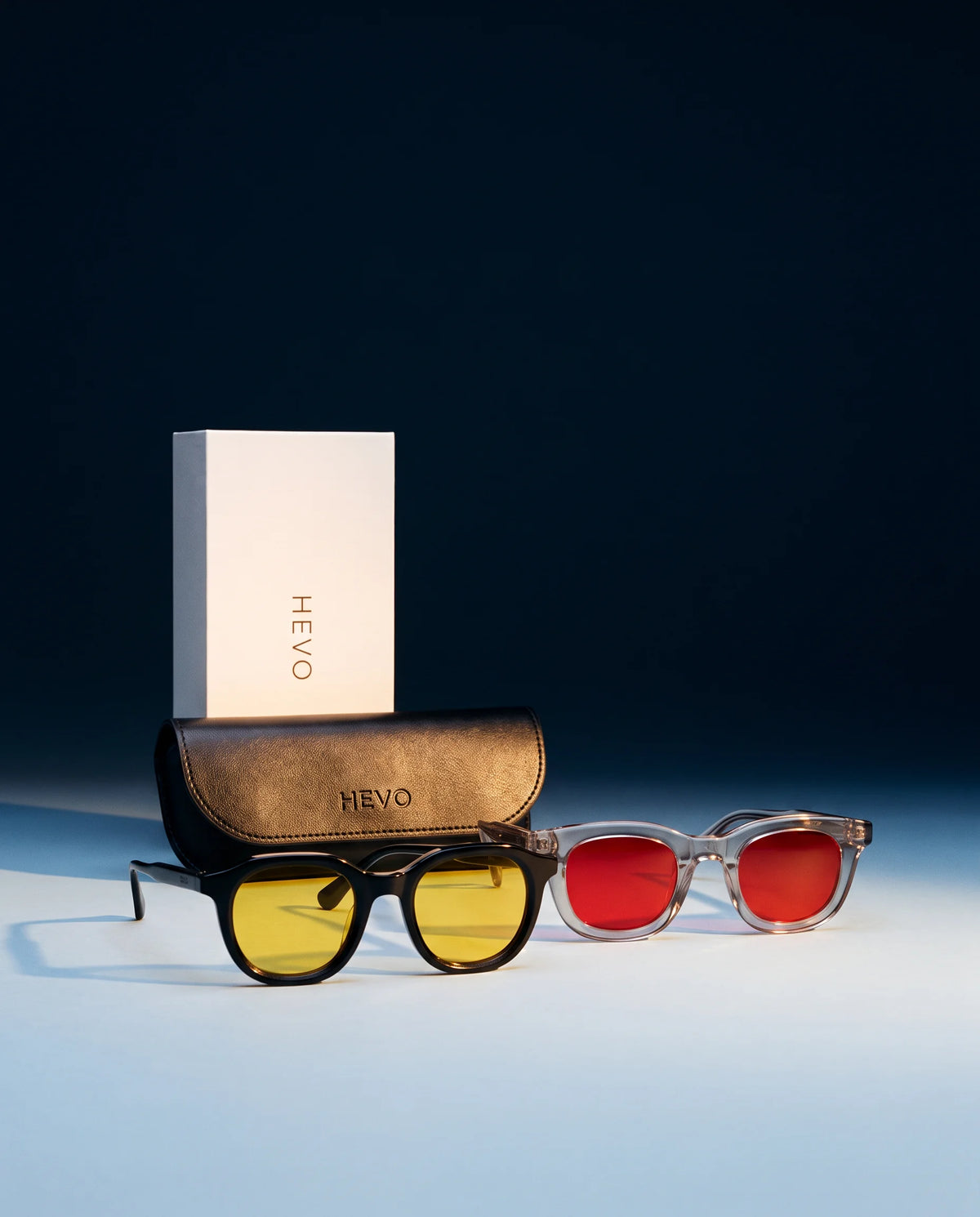
- Red lens: filters the widest band and is made for the last 1-2 hours before bed.
- Amber lens: filters most of the blue range and suits the early evening, when you want colours to look less red.
- Light yellow or clear lens: for daytime screens, not built for the evening.
We compare the colours in more detail in Red vs amber vs clear blue light glasses.
Why should a test check fit and whether you will wear them?
Glasses in a drawer filter nothing. A good test puts the frames on real faces and says who they fit. Will you wear these on the sofa, at dinner and while you read? If the frame pinches or you dislike how it looks, the filter value stops mattering.
Honest claims belong in the test too. Small randomised trials found that amber lenses in the evening improved self-reported sleep quality (Burkhart & Phelps, 2009), and that people with insomnia slept about 30 minutes longer on average with amber blue-blocking glasses than with clear placebo glasses (Shechter et al., 2018). A 2023 Cochrane review (Singh et al.) still rated the evidence on sleep as uncertain, because the studies are small. A brand that promises a cure should lose points. Read more in Do blue light glasses help you sleep?
How does HEVO answer each criterion?
The same checklist, filled in for HEVO:
| Criterion | HEVO |
|---|---|
| Filter band | Sleep Lens 400-560 nm, Relax Lens 400-500 nm, Focus Lens 400-450 nm |
| Filter percentage | 99%, 97% and 84% of the light within each band, measured with a spectrometer |
| Lens colour vs time of day | Red for the last 1-2 hours before bed, amber for the early evening, light yellow for screens by day |
| Frame fit and material | Acetate. Ion and Ceres 47-19-150 mm (most heads), Helios 44-19-150 mm (small to medium heads) |
| Will you wear them | 96.4% of customers keep their HEVO. Best design, Konsumentvalet 2026. Trustpilot 4.4/5 |
| Trial and returns | 100 evenings to try (return within 100 days). Free shipping on glasses from Sweden, 1-3 days |
| Honest claims | We say the evidence is uncertain and that the glasses can help some people wind down. They do not treat any condition. |
If you want the strongest filter for the hour before bed, start with Sleep Lens. And if sleep problems persist, talk to a doctor.
Questions
Can I trust "best in test" lists for blue light glasses?
Only if they show how they tested. A useful list states the filter band and percentage for each pair and says who the frames fit. If a list only covers looks and price, use the seven criteria above.
Is a red or an amber lens better for sleep?
Red filters a wider band. Sleep Lens filters 99% of 400-560 nm and Relax Lens filters 97% of 400-500 nm. Many people wear amber in the early evening and switch to red for the last 1-2 hours before bed.
Do I need a prescription to buy blue light glasses for sleep?
Not for HEVO. All HEVO glasses are non-prescription and worn on their own, not over prescription glasses.