



Last updated: 26 November 2026 · By HEVO
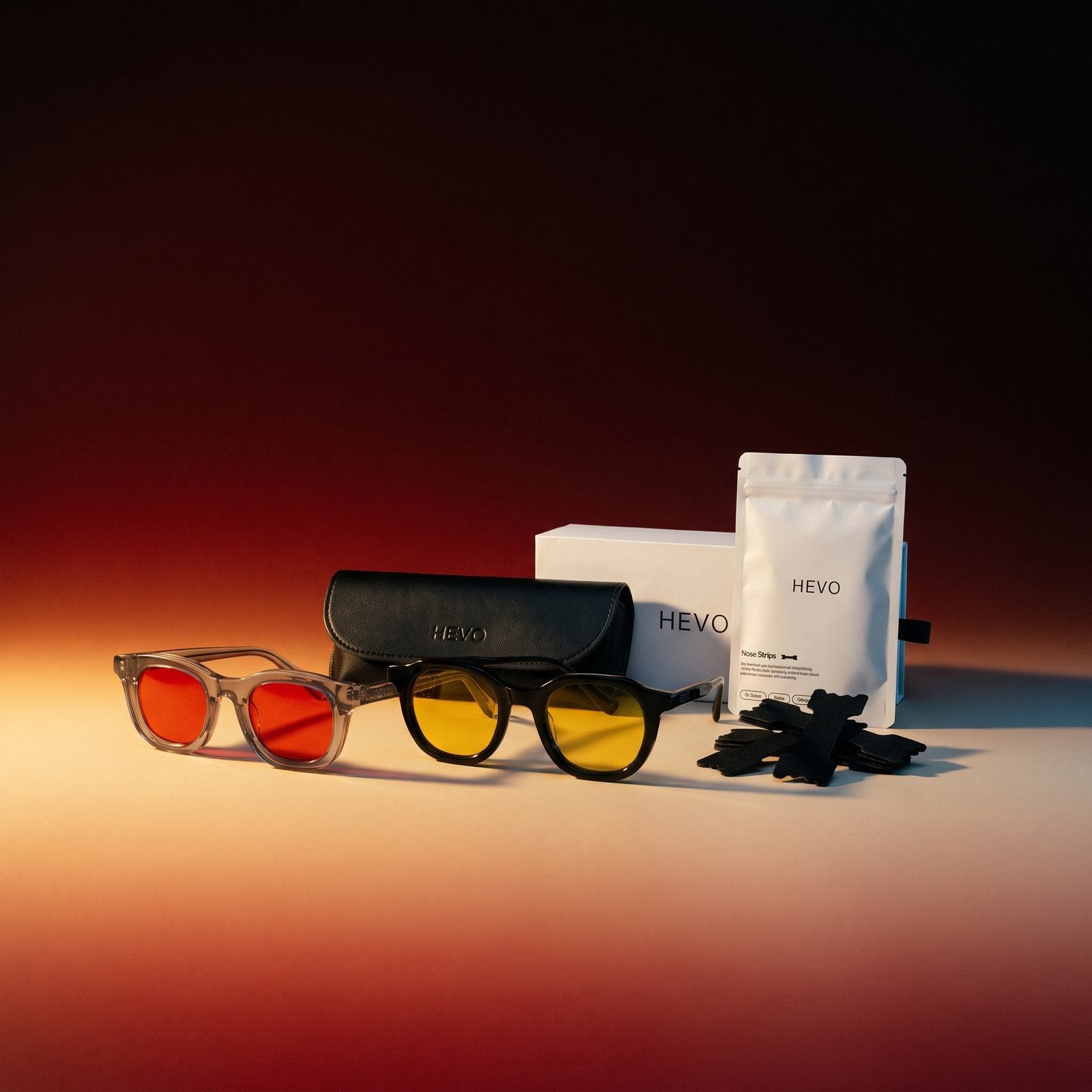
Non-prescription blue light glasses are glasses with a filtering lens but no corrective strength, so you can wear them without an eye test or a prescription. They suit you if you have normal vision or wear contact lenses, and they do one job: they filter part of the light that reaches your eyes. How much they filter depends on the lens colour. HEVO makes three non-prescription lenses, all in acetate frames. Sleep Lens is red and filters 99% of light between 400 and 560 nm, for the last 1-2 hours before bed. Relax Lens is amber and filters 97% of 400-500 nm, for the early evening. Focus Lens is light yellow and filters 84% of 400-450 nm, for screens during the day. For comparison, typical clear computer glasses filter roughly 20-30% of blue light. If you already wear prescription glasses, HEVO will not replace them, and further down we explain what you can do instead.
What does "without prescription" actually mean?
It means the lens has no corrective power. It does not make text sharper and it does not correct short or long sight. You see the way you normally see, only with less of certain wavelengths reaching your eyes. That is why you can order online without an eye test: there are no values to fill in.
Every HEVO lens is non-prescription. The glasses are made to be worn on their own, not on top of another pair.
Who are non-prescription blue light glasses for?
- You have normal vision and spend your evenings with screens or bright lamps.
- You wear contact lenses and want something for the evening.
- You want a simple routine: glasses on, lights down, wind down.
- You want to test for yourself whether filtering evening light makes a difference to you.
Be realistic about what to expect. Some small studies are encouraging. In a small randomised trial at Columbia, people with insomnia slept about 30 minutes longer on average with amber blue-blocking glasses than with clear placebo glasses (Shechter et al., 2018). A 2023 Cochrane review (Singh et al.) still rated the evidence on sleep as uncertain, because the studies are small. Blue light glasses can help some people wind down. They are not a treatment, and if sleep problems persist, talk to a doctor. We go through the research in Do blue light glasses help you sleep?
Which lens should you wear at which time of day?
Light affects your body clock most in the evening. For many people, melatonin starts rising in dim light about two hours before their usual bedtime. The melanopsin cells in the eye, which report light to the body clock, are most sensitive around 480 nm (Berson 2002; Hattar 2002). That is why the evening lenses cover more of the spectrum.
| Time of day | Lens | Colour | Filters |
|---|---|---|---|
| Daytime, at screens | Focus Lens | Light yellow | 84% of 400-450 nm |
| Early evening | Relax Lens | Amber | 97% of 400-500 nm |
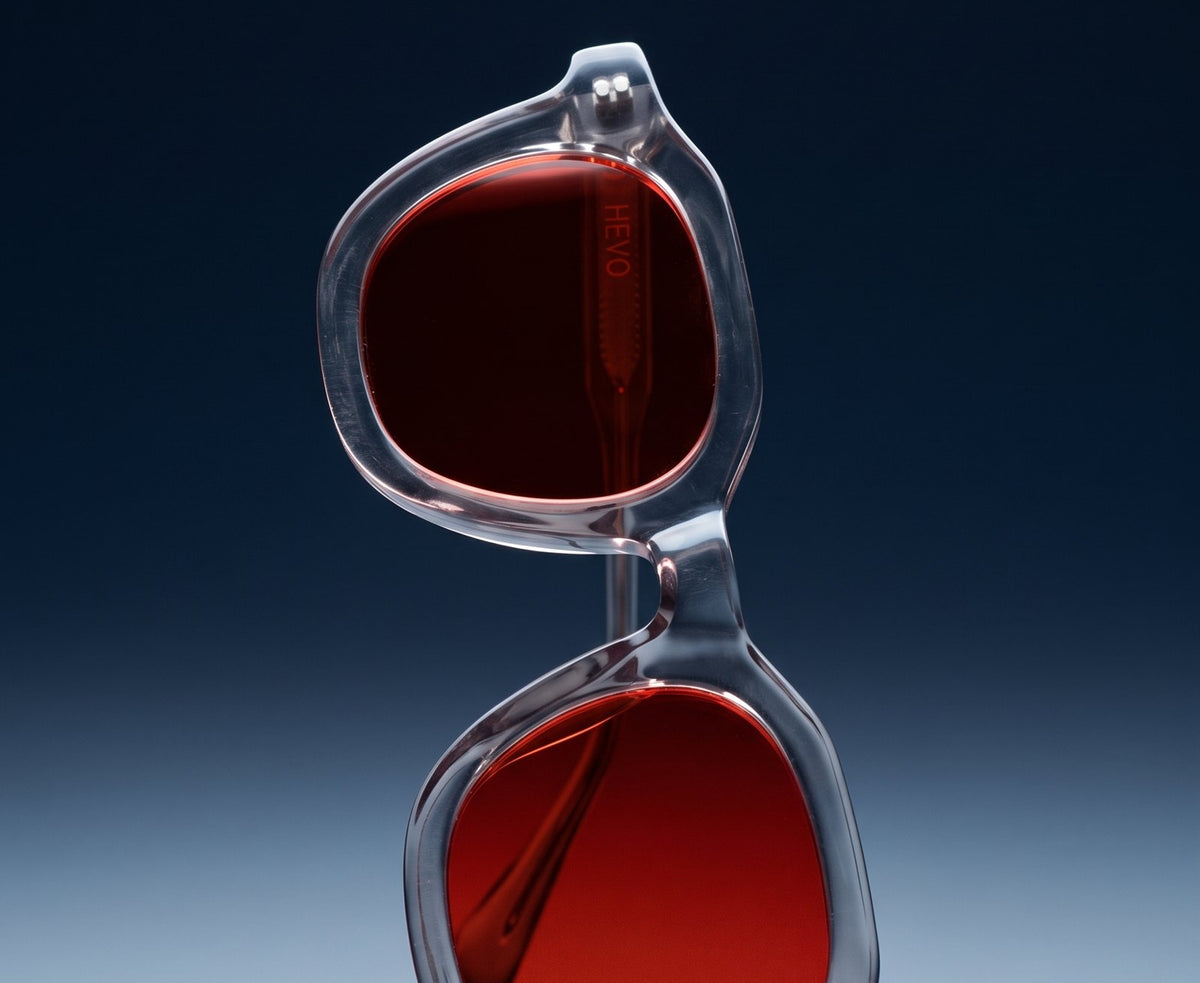
| Last 1-2 hours before bed | Sleep Lens | Red | 99% of 400-560 nm |
The percentage is the share of light inside that band that the lens filters out, measured with a spectrometer. Focus Lens gives only a small colour change, so it works for a normal workday. Sleep Lens makes everything clearly red, and that is the point. For a side by side look, read Sleep vs Relax vs Focus Lens.
What if you already wear prescription glasses?
We want to be straight with you here. HEVO lenses are non-prescription, and HEVO glasses are not made to fit over another pair. If you need correction to see well, you have two realistic options.
- Contact lenses plus HEVO. Wear your contact lenses as usual and put on your HEVO glasses in the evening. This is the simplest way to use any of the three lenses.
- Ask an optician about a tinted prescription lens. An optician can tell you whether a filtering or tinted lens is possible in your prescription. Ask for the measured filter band and percentage, so you can compare it with the numbers above.
How do you choose the right frame size?
Frame sizes are written as three numbers: lens width, bridge width and temple length, in millimetres.
| Frame | Size | Fits |
|---|---|---|
| Ion | 47-19-150 mm | Most heads |
| Ceres | 47-19-150 mm | Most heads |
| Helios | 44-19-150 mm | Small to medium heads |
Not sure? Look at a pair of glasses or sunglasses you already own. The size is often printed on the inside of the temple. If yours are closer to 44 and feel right, Helios is a good match. If they are closer to 47, go for Ion or Ceres. Colours include Black, Transparent, Fossil (grey), Umber (brown) and Grey.
You get 100 evenings to try, and shipping on glasses from Sweden is free and takes 1-3 days. So you can check the fit at home, in your own evening light. See all frames among our blue light blocking glasses.
Questions
Do I need an eye test to buy blue light glasses without prescription?
No. The lenses have no corrective strength, so there are no values to enter. You choose a lens and a frame, and that is it.
Can I wear HEVO over my normal glasses?
No. HEVO glasses are worn on their own. If you need correction, wear contact lenses with HEVO, or ask an optician about a tinted prescription lens.
Will non-prescription blue light glasses change how I see?
They do not change sharpness. They change colour: Focus Lens a little, Relax Lens to amber and Sleep Lens to red. Many people use Relax Lens in the early evening and switch to Sleep Lens for the last 1-2 hours before bed.