



Ottawa Charge player Ronja Savolainen on why stopping is harder than training.
Ronja Savolainen was born in Helsinki and has played professional hockey since she was a teenager — first in Finland, then eight seasons in Sweden with Luleå, where she won six championships. She was drafted eighth overall by the Ottawa Charge in 2024 and has spent the last three seasons in the PWHL. She has two Olympic bronze medals with Finland.
We asked her four questions and let her talk.
You've played professionally since your teens, in Finland, Sweden and now North America. What did you have to figure out about taking care of yourself that nobody taught you?
The hockey part I was prepared for. Someone had always taught me how to train, what to eat before a game, how to handle an injury. What I wasn't prepared for was everything around it. You move to a new country and the club takes care of the hockey, but the other twenty hours of the day are yours, and at that age you don't know what to do with them.
For a while my answer to any problem was to train more, because that was the tool I understood. If I felt off, I did extra. And sometimes the thing making me feel off had nothing to do with hockey, so more hockey didn't touch it. Learning to tell those two apart took me years, and I'd say it's the single most useful thing I know now.
You describe health as taking care of both body and soul. Most athletes only talk about the body — what does the other half actually mean?
I use that word on purpose, because I've had weeks where my body was in good shape, tested well, no injuries, and I still wasn't enjoying anything. Practice felt like something to get through. If it were only about the body that wouldn't happen.
So the other half is the part that decides whether I want to be there. Am I looking forward to going to the rink. Do I have a life outside it. And food is a bigger piece of this than people think — eating well doesn't only mean nutrients to me, it means eating something I actually like. If every meal is fuel you've measured, you lose something. I'd rather cook properly, sit down, enjoy it, and have that be part of the day I look forward to. It's still good food. It's just not punishment.
Those sound like soft questions but they show up in my hockey faster than anything I do in the gym, and they're harder to work on, because you can't tick them off a list. I know exactly what to do when my legs are heavy. I've had to learn what to do when it's the other thing.
What do you have to be willing to give up to not stress unnecessarily?
Being good at everything. When I was younger I wanted to be the best trained, the best prepared, the best teammate, the best at the extra work, and completely fine as a person on top of it. You can hold that for a while, but it means every single day contains something you've failed at.
The practical version is that I gave up the things I can't control. Ice time, selections, what somebody thought of a shift I played. I used to take all of that home and turn it over for two days. Now I try to leave it at the rink, and when I manage it my sleep is better and my next week is better — the connection is that direct for me.
I haven't mastered this. There are still weeks where I take everything home with me. But I've stopped treating that as normal, which is different from where I was at twenty-two.
What does a good day look like from waking up to falling asleep — and where does it usually go wrong?
A good day is calm and slightly boring. I sleep until I wake up, I eat properly rather than quickly, I get outside early even in winter, I train, and then there's a long stretch of the day where nothing is required of me. That empty part is what I protect hardest. It isn't lazy. It's the reason the rest of it works.
Where it goes wrong is the evening, and it isn't for the reason people assume. My family is seven hours ahead, so they're asleep by three or four in the afternoon my time. After that the evening is long and there's nothing in it. And I can't sit still in that. I clean the apartment for the millionth time, I put on a wash, I go out for another walk, I move furniture around — anything to make the time pass. Which is the exact opposite of what I need, because now I'm wide awake at ten at night wondering why my body won't come down.
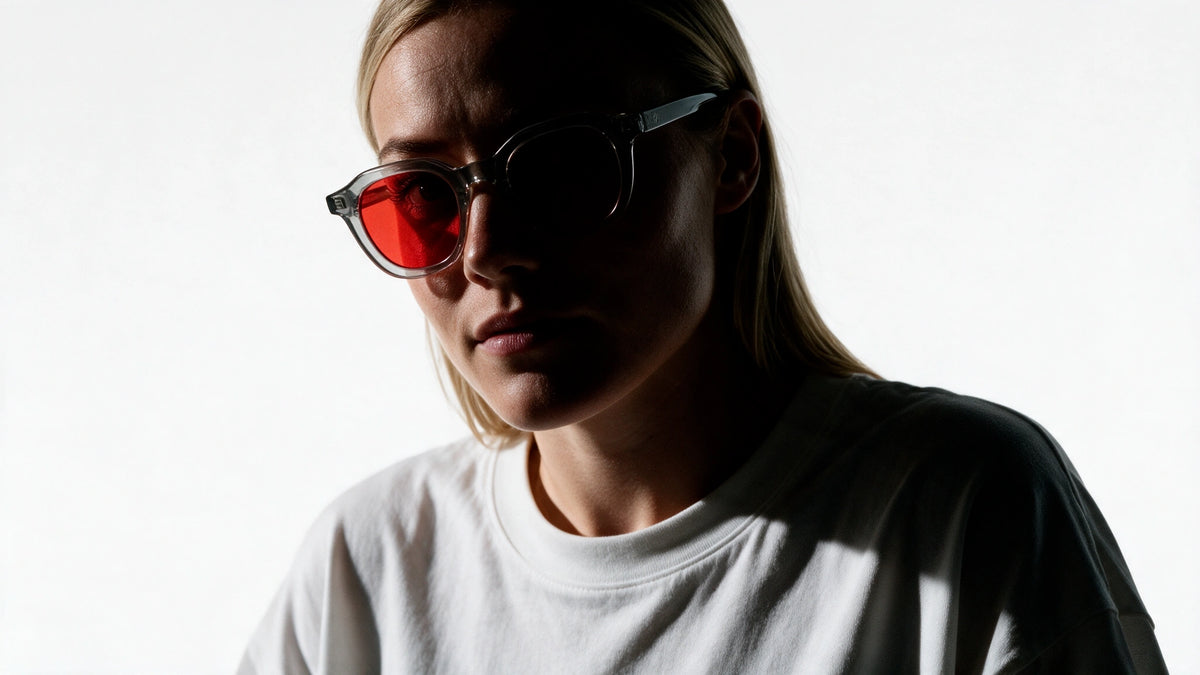
I have ADHD, and calming my body down has always been the hard part for me. So the thing that's helped is having a signal that the day is over. I put HEVO on around eight, which is when I let myself sit down and watch TV, and that's become the marker. They help me wind down and I can see it in my Oura score, which is what convinced me it wasn't just in my head. What I like about it is that it costs me nothing. No discipline, no willpower, I just put them on. Finding the tools is half of it. Sticking with them every day is the other half, and this is the first one I've actually managed to keep.
