


Last updated: 26 November 2026 · By HEVO
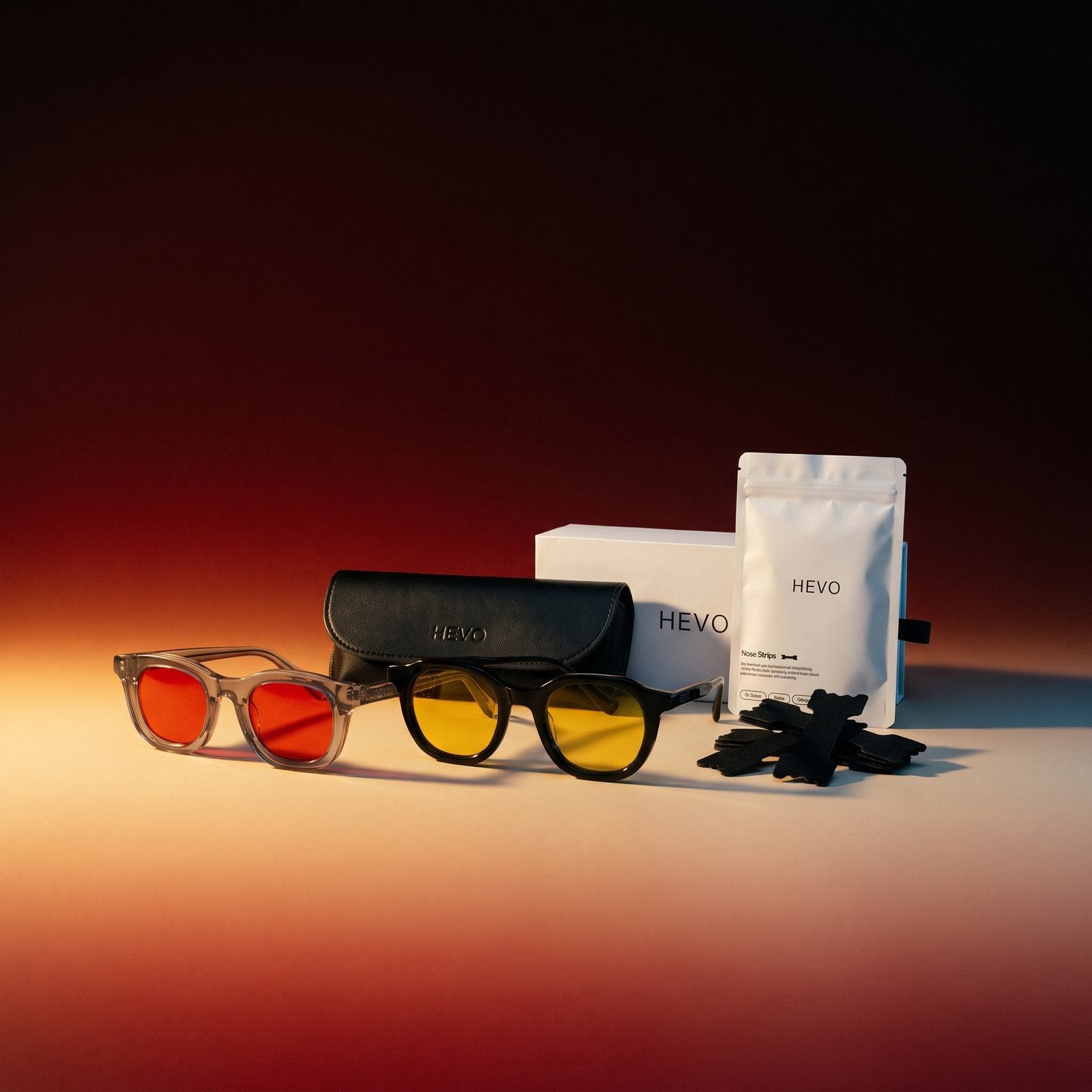
For sleep, red lenses filter the most light, amber lenses come next and clear lenses filter the least. The difference is which wavelengths each colour stops. The body's clock responds most to light around 480 nm, so a lens meant for the evening needs to block the blue range (400-500 nm) and part of the green. HEVO's red Sleep Lens filters 99% of light between 400 and 560 nm. The amber Relax Lens filters 97% of 400-500 nm. A light yellow lens like HEVO Focus filters 84% of the short 400-450 nm band, which takes the edge off screens during the day but leaves much of the light the clock reacts to in the evening. Typical clear "computer glasses" filter about 20-30% of blue light. The trade-off is colour: red changes how colours look the most, which is why it is meant for the last 1-2 hours before bed rather than all day.
Comparison
| Lens colour | Typical filtering | Range | Best for | Colour change |
|---|---|---|---|---|
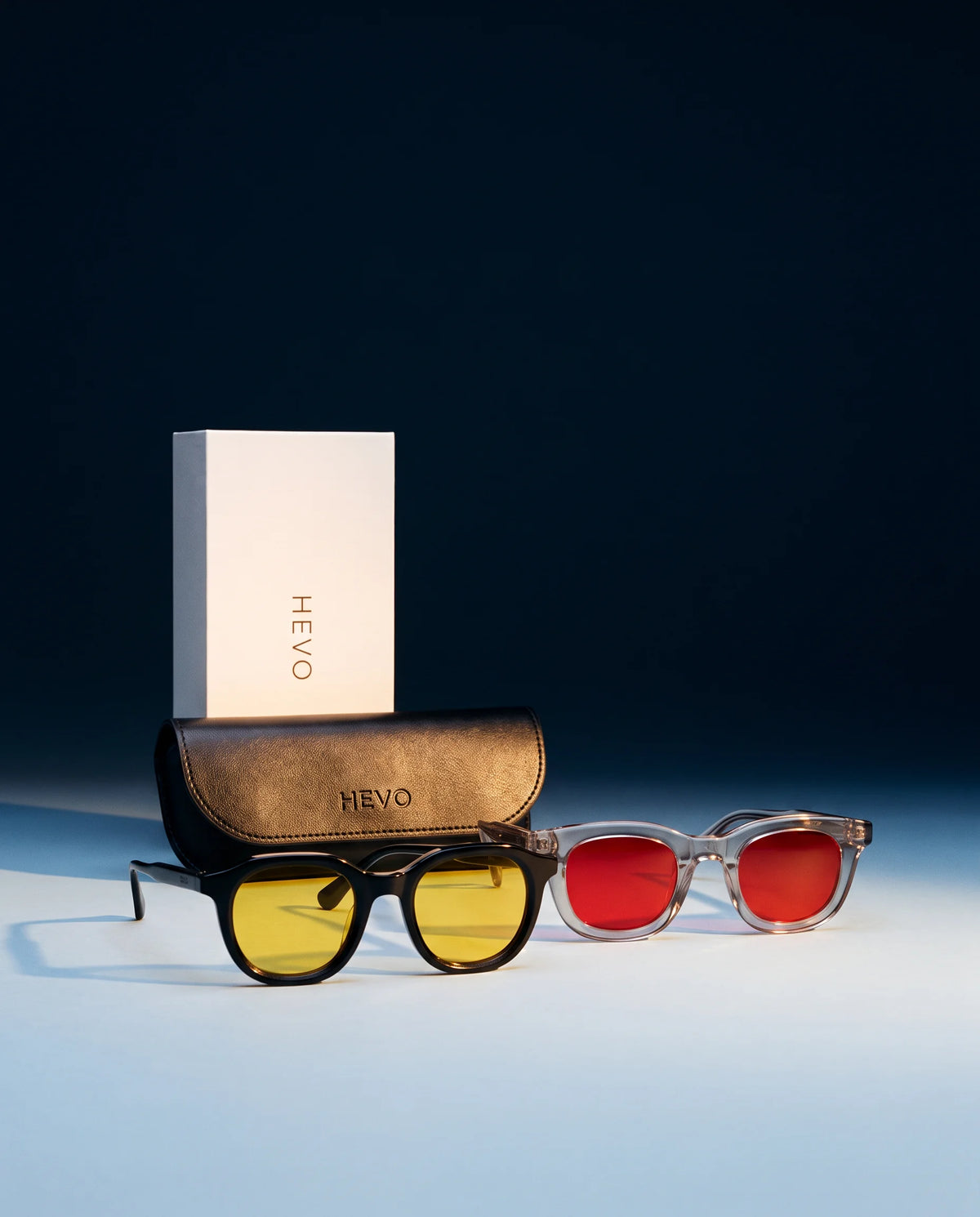
| Red (HEVO Sleep Lens) | 99% | 400-560 nm | Last 1-2 h before bed | Strong |
| Amber (HEVO Relax Lens) | 97% | 400-500 nm | Early evening | Clear |
| Light yellow (HEVO Focus Lens) | 84% | 400-450 nm | Screens during the day | Slight |
| Ordinary clear "blue light" lens | About 20-30% | Short blue only | Little effect at night | None |
Why does colour matter so much?
A lens can only block light by absorbing it, so a lens that looks clear lets most light through. The deeper the tint, the more of the spectrum it removes. If a lens looks completely clear, it is not blocking much of the evening light.
Which should you choose?
- To wind down before bed: red (Sleep Lens).
- For the sofa in the early evening: amber (Relax Lens).
- For a screen-heavy workday: light yellow (Focus Lens).
How to check a lens yourself
You do not need a lab to judge blue light glasses. Go through these points before you buy, whichever brand you are looking at.
- Is the band stated? A good product page tells you which wavelengths the lens covers, for example 400-500 nm. “Blocks blue light” on its own tells you little.
- Is there a measured percentage? Look for the share of light filtered inside that band, and ideally how it was measured, for example with a spectrometer.
- Does it filter beyond 450 nm? The cells that report light to your body clock are most sensitive around 480 nm. A lens that stops at 450 nm can work well for screens during the day, but in the evening it leaves that area open.
- What colour is the lens? Clear lenses typically filter roughly 20-30% of blue light. Amber and red lenses filter more, and the trade-off is that colours change. A lens that looks fully clear but is said to stop nearly all blue light deserves a closer look.
- Does the frame fit? Compare the measurements (lens width, bridge and temple length, such as 47-19-150 mm) with glasses you already own. Light that leaks in around a loose frame is not filtered.
- Can you try them? A trial period lets you test them on your own evenings. At HEVO you get 100 evenings.
Our own measured numbers are listed on HEVO in brief.
Questions
Will everything look strange through red lenses?
Colours shift, which is how you know the lens is working. Most people stop noticing within a few minutes.
Can I watch TV or use my phone with red lenses?
Yes. That is the point: you keep your evening as it is.
Sources
- Shechter A, Kim EW, St-Onge MP, Westwood AJ (2018). Blocking nocturnal blue light for insomnia: a randomized controlled trial. Journal of Psychiatric Research.
- Burkhart K, Phelps JR (2009). Amber lenses to block blue light and improve sleep: a randomized trial. Chronobiology International.
- Gooley JJ et al. (2011). Exposure to room light before bedtime suppresses melatonin onset and shortens melatonin duration in humans. Journal of Clinical Endocrinology & Metabolism.
- Chang AM et al. (2015). Evening use of light-emitting eReaders negatively affects sleep, circadian timing, and next-morning alertness. PNAS.
- Brainard GC et al. (2001). Action spectrum for melatonin regulation in humans. Journal of Neuroscience.
- Singh S et al. (2023). Blue-light filtering spectacle lenses for visual performance, sleep, and macular health in adults. Cochrane Database of Systematic Reviews.
More on the biology: The science behind HEVO.