


Last updated: 26 November 2026 · By HEVO
Melatonin supplements add the hormone to your body, while blue light glasses add nothing at all: they filter the evening light that can hold back your body's own melatonin release. Your body makes melatonin in the evening, and for many people it starts rising in dim light about two hours before their usual bedtime. Bright light during that time can delay it. Glasses work on the light side. A supplement works on the hormone side. They are different tools, and one is not a swap for the other. Rules for melatonin differ between countries, so ask a pharmacist or doctor before you take it. Never stop a medicine you have been prescribed without talking to your doctor first. This guide compares the two, sums up what the research on glasses shows and tells you when it is time to get help. HEVO sells glasses, not melatonin, so keep that in mind as you read.
What is the difference between melatonin and blue light glasses?
Melatonin is a hormone your body makes when the evening gets dark. It is one of the signals that tells your body it is night. A melatonin supplement adds the hormone from outside, as a tablet or a similar product.
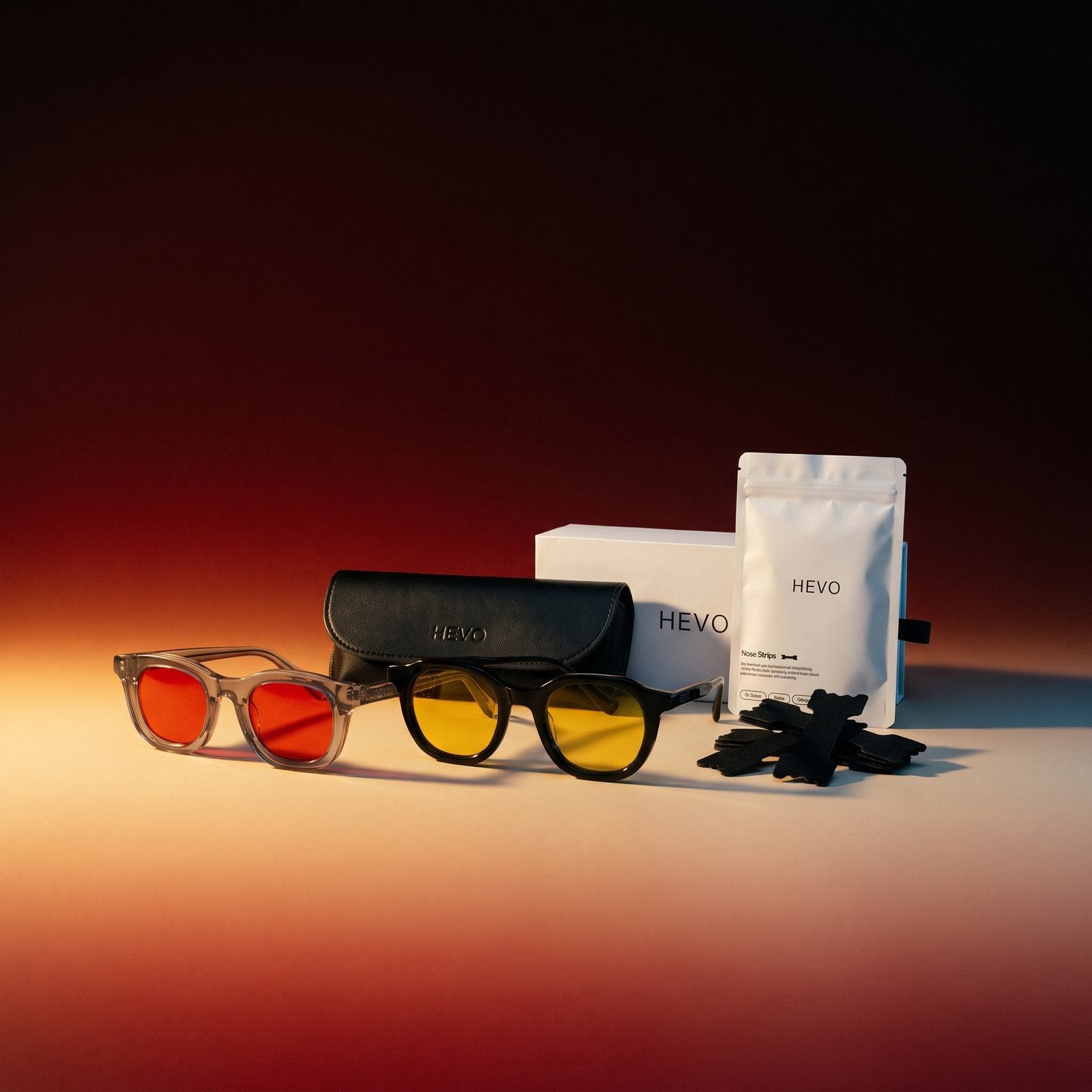
Blue light glasses contain no active substance. They are a filter in front of your eyes. They reduce the light that reaches the eye in the evening, and that light is the signal that can hold back your own melatonin.
How does evening light affect your own melatonin?
Cells in the eye that contain melanopsin are most sensitive to light around 480 nm. They report light to the body clock in the brain (Berson, 2002; Hattar, 2002). In a study by Gooley and colleagues (2011), ordinary room light before bedtime held back the start of melatonin and shortened how long it lasted. Chang and colleagues (2015) found that reading on a light-emitting tablet before bed suppressed melatonin and made it take longer to fall asleep, compared with a printed book.
Evening light at home is often 50-200 lux. A full moon gives 0.1-0.3 lux. Sleep Lens filters 99% of light between 400 and 560 nm. Relax Lens filters 97% of 400-500 nm. Typical clear "computer glasses" filter only about 20-30% of blue light.
What should you know about melatonin supplements?
Rules for melatonin differ between countries. Ask a pharmacist or doctor whether it suits you, how to use it and whether it fits with any other medicines you take. We do not give dosing advice.
If you already take melatonin or any other medicine, do not stop or change it on your own. Talk to the person who prescribed it.
How do melatonin and blue light glasses compare?
| Melatonin supplement | Blue light glasses | |
|---|---|---|
| What it does | Adds the hormone melatonin from outside | Filters evening light that can hold back your own melatonin |
| When | As advised by a pharmacist or doctor | Evening: amber in the early evening, red for the last 1-2 hours before bed |
| How it works | Raises the level of the hormone directly | Reduces the blue and green light that reaches the eye |
| Things to consider | Rules differ between countries. Ask about other medicines you take. No dosing advice here. | No active substance. Filters only while you wear them. Evidence on sleep is low certainty. |
What does the research on blue light glasses say?
In a small randomised trial at Columbia, people with insomnia slept about 30 minutes longer on average with amber blue-blocking glasses than with clear placebo glasses (Shechter et al., 2018). A 2023 Cochrane review by Singh and colleagues judged the evidence on sleep as uncertain, with low certainty, mainly because the studies are small. Read more in do blue light glasses help you sleep.
We do not summarise research on melatonin supplements here. A pharmacist or doctor can give you advice that fits you.
When should you talk to a doctor?
- Your sleep problems last for weeks or keep coming back.
- You are very tired during the day, even after a full night in bed.
- Someone notices that you stop breathing or gasp in your sleep.
- You are thinking about melatonin and take other medicines, are pregnant or breastfeeding, or it is for a child.
Glasses can help some people wind down, but they do not treat any condition.
Questions
Can I use blue light glasses if I take melatonin?
Glasses contain no active substance. They only filter light. Whether melatonin is right for you, and how to take it, is a question for a pharmacist or doctor.
Can I sleep better without melatonin?
A good place to start is light: dimmer lamps, fewer screens late at night, daylight in the morning and glasses for the last hours of the evening. It can help some people wind down, but nothing is guaranteed. If sleep problems persist, talk to a doctor.
How long before bed should I wear the glasses?
Wear Sleep Lens for the last 1-2 hours before bed, and Relax Lens earlier in the evening if you like. Read when to wear blue light glasses before bed for a full timeline.
Sources
- Berson DM et al. (2002), Phototransduction by retinal ganglion cells that set the circadian clock, Science.
- Hattar S et al. (2002), Melanopsin-containing retinal ganglion cells: architecture, projections, and intrinsic photosensitivity, Science.
- Gooley JJ et al. (2011), Exposure to room light before bedtime suppresses melatonin onset and shortens melatonin duration in humans, Journal of Clinical Endocrinology and Metabolism.
- Chang AM et al. (2015), Evening use of light-emitting eReaders negatively affects sleep, circadian timing, and next-morning alertness, PNAS.
- Shechter A et al. (2018), Blocking nocturnal blue light for insomnia: a randomized controlled trial, Journal of Psychiatric Research.
- Singh S et al. (2023), Blue-light filtering spectacle lenses for visual performance, sleep, and macular health in adults, Cochrane Database of Systematic Reviews.